
AI Mania: When Technology Becomes the Product
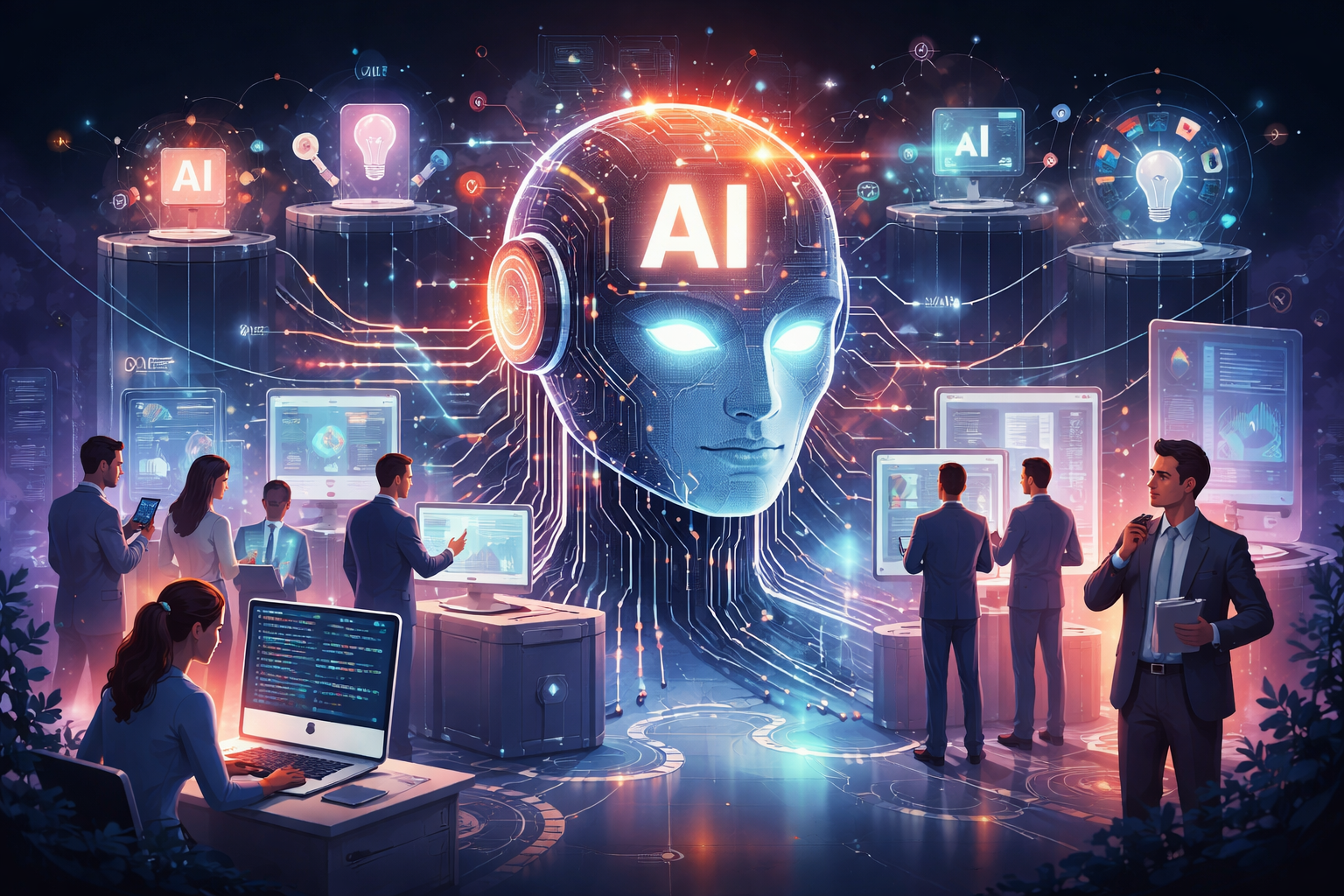
We are witnessing a familiar pattern in the technology industry. Every major wave—cloud, mobile, blockchain, big data—has triggered a phase where the technology itself becomes the centerpiece. Artificial Intelligence is no exception. However, AI amplifies this phenomenon because it appears to “think,” decide, and produce autonomously. It does not simply enhance products; it risks redefining them.
“AI Mania” describes the growing tendency to inject AI into products to appear modern, innovative, and competitive—sometimes without re-examining the original problem the product was meant to solve. Teams build with AI, test with AI, prioritize with AI, and increasingly delegate decision-making to AI agents. In isolation, each of these uses can be valuable. The issue arises when this delegation is no longer challenged or contextualized.
From Problem-First to Tech-First
Strong products traditionally emerge from a clear understanding of user needs. They start with a specific pain point and define value accordingly. AI Mania reverses this logic. The question shifts from “What problem are we solving?” to “Where can we add AI?” or “How can we automate this profession?”
The problem becomes secondary. Sometimes it is reconstructed after the fact to justify the technology. Instead of solving a validated need, teams attempt to invent needs that fit AI capabilities.
This shift produces a deeper transformation: products gradually become technology-driven rather than value-driven. Decisions are guided by what is technically feasible, scalable, or optimizable, not by what is meaningful to users.
The Risk of Product Deformation
When AI becomes the focal point, products risk drifting away from their original intent. Complex, nuanced, human-centered workflows are flattened into automated pipelines. Interfaces become more opaque. Decision logic becomes harder to explain. User experience adapts to the model’s constraints rather than the other way around.
The result is often a “pure tech” product—impressive in engineering terms but disconnected from real-world context. It optimizes internal metrics instead of solving actual problems.
Delegating Product Thinking to AI
A more subtle but significant risk is the growing reliance on AI for core product functions: generating specifications, drafting roadmaps, running experiments, analyzing feedback, or even prioritizing features. These practices can accelerate execution. However, speed without judgment creates fragility.
AI systems lack accountability. They do not bear responsibility for strategic coherence, long-term trade-offs, or ethical implications. When their outputs are accepted without rigorous human challenge, product thinking becomes shallow and reactive.
In this environment, there is a temptation to marginalize product-oriented roles—Product Owners, Product Managers, Business Analysts, or Agile Coaches—in favor of more technical teams. The assumption is that if AI can generate documentation and engineers can execute rapidly, intermediary roles become redundant.
This assumption is dangerous.
Product roles exist precisely to navigate ambiguity, arbitrate trade-offs, synthesize qualitative insight, and align solutions with business strategy. These dimensions cannot be reduced to automated optimization.
North Star Metrics vs. Technical Metrics
A healthy product organization anchors itself in a North Star Metric that reflects real user or business value: time saved, friction reduced, outcomes improved, meaningful engagement created.
AI Mania often replaces this orientation with technical indicators: automation rates, model accuracy, processing volume, cost reduction. These metrics are not irrelevant, but they are insufficient. A highly accurate model solving the wrong problem remains a failure from a product perspective.
Optimizing model performance is not equivalent to delivering value.
The Illusion of Full Automation
Many professions are not “AI-ready” in a simplistic sense. They involve judgment, context, ethical reasoning, and accountability. Attempting to fully automate such roles often produces systems that perform well in controlled environments but fail under real-world complexity.
AI can augment expertise. It rarely replaces it without loss.
Reducing complex human work to an “AI-compatible function” strips away nuance and responsibility. In doing so, products may become efficient but less trustworthy, less adaptable, and less aligned with user realities.
Re-centering Vision
The alternative is not resistance to AI. It is resistance to uncritical adoption.
AI should remain a lever, not a North Star. A powerful capability in service of a clear product vision. Organizations must preserve strong product governance, maintain roles capable of challenging technological enthusiasm, and continuously return to the foundational question: what problem are we solving, and for whom?
The most enduring AI-enabled products will likely be those where AI is almost invisible—deeply integrated, carefully constrained, and entirely subordinated to user value.
The core discipline remains unchanged: define the problem, articulate the value, measure impact through meaningful metrics, and treat technology as a means—not the product itself.